How Property Taxes Work in Ocean City MD: What Buyers Should Know (2026)
If you're shopping for a condo, townhome, or single-family home in Ocean City, MD, the property tax conversation is skipped over too often (or it shows up late in the process).
The goal of this blog is to give you all the information you need, in one neat bundle. Grant Fritschle (and his team at the Fritschle Barker Group) have spent nearly three decades specializing in resort real estate, and the property-tax piece is one of the most consistently misunderstood (and improperly explained) parts of the transaction. The good news: once you read this blog you'll have a solid foundation and clear understanding of Ocean City property taxes.
Quick Answer: Ocean City property taxes for fiscal year 2026 are made up of three different pieces: a State rate of $0.112 per $100 of assessed value, a Worcester County rate of $0.815, and a town of Ocean City rate of $0.4426, totaling roughly $1.37 per $100 of property value. In other words, for a property that is currently assessed at $400,000 the taxes work out to about $5,500 per year.
Jump To Section
- The three parts of an Ocean City property-tax bill
- Statutory rate vs. what you'll actually pay
- How to forecast your next two tax bills
- How tax burden differs across Ocean City
- The West Ocean City tax advantage
- Maryland's nonresident withholding tax (now 8.75%)
- The Homestead Tax Credit and who qualifies
- How and when to appeal your assessment
- FAQs
- Questions to answer before you write an offer
The Three Layers of an Ocean City Property Tax Bill

Quick Answer: Ocean City property taxes are broken down into three parts. A MD State portion, a Worcester County portion, and a town of Ocean City portion. These three parts create a statutory rate of roughly 1.37% of assessed value for 2026.
Important Fact: Most Maryland counties have just two layers (state and county). Ocean City adds a third because it's an incorporated town with its own budget and services.
Here's how the FY2026 rates stack up:
| Tax Layer | Rate (per $100 of assessed value) | What it funds |
|---|---|---|
| State of Maryland | $0.112 | State operations, education funding |
| Worcester County | $0.815 | County services, schools, public safety, roads |
| Town of Ocean City | $0.4426 | Beach patrol, public works, police, fire, EMS, town operations |
| Combined total | $1.3696 |
A few notes most buyers don't realize until later:
- Worcester County collects all three and writes one bill. You don't get separate invoices from the state and town.
- Bills are mailed each July. Pay in July and you get a 0.5% discount on the county portion. Small, but real money on a $5,000 bill.
- The fiscal year runs July 1 through June 30, not the calendar year.
- Worcester County has the second lowest property tax rate of all 24 Maryland counties and the lowest local income tax rate.
Statutory Rate vs. What You'll Actually Pay

Quick Answer: Worcester County reassesses Ocean City properties every three years. When the new assessed value comes in higher, the increase is phased in equally over the three-year cycle, so most owners are taxed on a value below their current market value during years one and two of the cycle.
Here's the most consistently misunderstood part of how Ocean City property taxes work: the rate you see on the tax rolls and the assessed value the rate gets applied to are two different things, and the assessed value is usually a moving target.
Triennial Assessment
Worcester County reassesses every property on a three-year cycle. When the new assessed value comes in higher than the prior one, the increase is then phased in over the next three years. The taxable assessment steps up by one-third of the increased value each year for three years. Then it's re-assessed and the cycle starts over.
Here's how it works with a real example. Say a property was previously assessed at $100,000 and the new reassessment comes in at $200,000:
| Year | Taxable Assessed Value | Tax Bill at 1.37% |
|---|---|---|
| Year 1 of cycle | $133,333 (prior $100K + 1/3 of the $100K increase) | $1,827 |
| Year 2 of cycle | $166,667 (prior $100K + 2/3 of the $100K increase) | $2,283 |
| Year 3 of cycle | $200,000 (full new value) | $2,740 |
After year three, the assessment locks at the new full value until the next three-year reassessment.
How to Forecast Your Next Two Tax Bills

Quick Answer: To estimate your next two years of tax bills, you first need to determine which year of the three-year reassessment cycle the property is in and whether the assessment is still phasing up. The annual increase is roughly one-third of the gap between the prior assessed value and the current full value.
Most buyers ask "what are the taxes?" and stop looking beyond the current tax-bill. That's the wrong question if the property is in year one or year two of a phase-in. The better question is "what will my taxes be in years one, two, and three of ownership."
Pull the property card from Worcester County's online records. It will show the prior assessed value, the current full assessed value, and the phase-in schedule for the next two years. Apply the combined tax rate (roughly 1.37% in OC proper, 0.93% in West OC) to each year's phased-in value and you have a defensible forecast. The number that lands on your settlement statement is rarely the number you'll be paying two years from now.
A practical note: Properties are sometimes assessed above their current market value. If you're buying one of those, there is an appeal process through Worcester County, and it's likely worth your time.
How Tax Burden Differs Across Ocean City
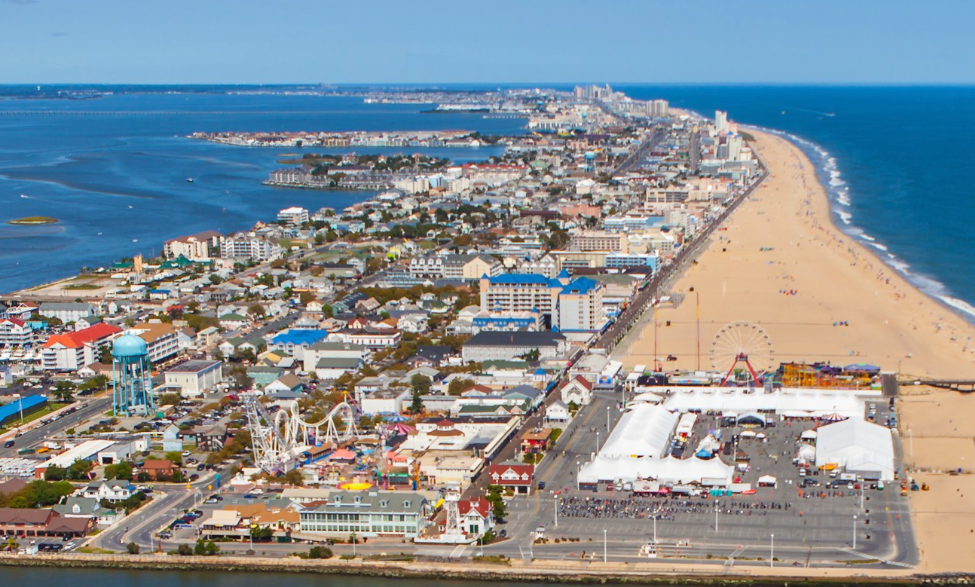
Quick Answer: Annual property tax bills in Ocean City typically range from about $2,200 to over $10,000 depending on neighborhood and price point. The effective rate is consistent townwide, but the dollar amounts scale directly with property value.
We pulled all closed Ocean City sales from January 2025 through April 2026 and grouped them by zone. The table below shows the median sale price and median annual tax bill in each part of town:
| Ocean City Zone | Median Sale Price | Median Annual Tax |
|---|---|---|
| Midtown OC (28th to 60th St) | $381,000 | $3,347 |
| Far North OC (131st St+) | $400,000 | $3,538 |
| North OC (91st to 130th St) | $440,000 | $3,911 |
| Downtown OC (1st to 27th St) | $513,500 | $4,192 |
| Uptown OC (61st to 90th St) | $520,000 | $5,151 |
| Boardwalk/Downtown South | $578,750 | $5,371 |
A few takeaways:
- The effective tax rate is consistent across all of Ocean City. You're not paying a higher rate uptown vs. downtown. You're just buying at a different price point.
- Buildings with elevated assessed values, typically newer luxury construction like Gateway Grand, Meridian, and Belmont Towers, produce higher annual bills, but their effective rate matches everyone else's.
- For more on how building selection affects your total cost of ownership, see our guide to choosing the right condo building in Ocean City.
.png)
The West Ocean City Tax Advantage

Quick Answer: West Ocean City properties don't have to pay the Town of Ocean City tax, leaving them with only the state and county portions. The result is an effective rate of roughly 0.93%, versus 1.37% for properties on the island of Ocean City.
This is one of the most overlooked financial differences in the OC market. Cross the Route 50 bridge and a buyer goes from a roughly 1.37% statutory rate to a roughly 0.93% rate on the same assessed value.
In dollars: a $500,000 home in Ocean City proper pays roughly $6,850/year in property taxes. The same $500,000 home in West Ocean City pays roughly $4,635/year, a savings of about $2,200 per year, or $66,000 over a 30-year hold.
A few important caveats:
- Some pockets of far North Ocean City on the bayside also fall outside the town limits and follow the same lower-rate structure. These properties are rare but they exist. Your agent should know which they are.
- Lower property taxes do not mean lower HOA or condo fees. Those are separate and are governed by your building. See our condo fees guide for the full picture there.
Maryland's Nonresident Withholding Tax (Now 8.75% as of 2026)
Quick Answer: This is not an annual property tax. It's often called a sales-tax or exit-tax, but in reality it's an income tax. The State of Maryland charges non-resident property owners this tax when they sell their Maryland based property. As of January 1, 2026, Maryland increased the nonresident withholding tax to 8.75% for individual sellers and 8.25% for entities. This is collected at closing on real estate sold by anyone who isn't a Maryland resident. You only have to pay this tax on total proceeds/profits, and should work with an accountant to make sure the appropriate amount is being collected.
If you're actively buying a beach-house, this might not be at the top of your mind. But if you ever sell, it's something we want you to be aware of, so you can plan for it, and you can properly minimize any taxes paid.
Maryland requires a withholding payment at the closing of any real estate sale where the seller is not a Maryland resident. It's not technically a tax. It's an estimated prepayment toward any income tax the seller owes on the gain. But functionally, it's a chunk of cash that gets held back at settlement.
The 2026 update most articles haven't caught: effective January 1, 2026, the rate jumped from 8% to 8.75% for individual nonresident sellers and remains at 8.25% for nonresident entities.
Here's how it actually plays out:
- The withholding is calculated on net proceeds (sale price minus mortgage payoff and reasonable closing costs), not the gross sale price.
- Sellers can apply for a partial or full exemption from the Maryland Comptroller, but the application has to be submitted at least 21 days before closing. Miss that window and the full withholding gets collected at the table. The seller can apply for a refund afterward, but it takes 60+ days.
- If the property had multiple owners and only one was a nonresident, the withholding only applies to that owner's share.
- The withholding is not an additional tax. The seller will reconcile the actual tax owed when they file their Maryland nonresident return; whatever was over-withheld gets refunded.
If you're working with our team and live out of state, we'll help you get everything you need and get in touch with applicable experts early, usually at the time we go under contract, so you're not surprised at the closing table.
The Homestead Tax Credit and Who Qualifies

Quick Answer: The Maryland Homestead Tax Credit caps how much a property's taxable assessment can rise each year for primary residents only. In Ocean City, that cap is set at 0%, meaning eligible primary residents see no annual increase in their taxable assessment.
If you're buying a primary residence in Ocean City, meaning you actually live there at least six months of the year, not a vacation home or rental, you should know about the Homestead Tax Credit.
The state caps the year-over-year increase in your taxable assessment at a percentage set by each jurisdiction. In Ocean City, that cap is 0% for primary residents who file the homestead application. For Worcester County (covering West Ocean City and other unincorporated areas), the cap was historically 3% but was approved to drop to 0%.
Practical points:
- You have to apply. The credit isn't automatic. Maryland's SDAT processes the application.
- It only applies to owner-occupied primary residences. Vacation homes, second homes, and investment rentals don't qualify.
- If you're buying a property as a future primary residence (planning to retire to OC), you can apply once you've moved in.
- The credit can save real money over time, especially when assessments are climbing.
How and When to Appeal Your Assessment

Quick Answer: Maryland property owners can appeal their assessment within 45 days of receiving the assessment notice, or within 60 days of purchase if the new owner believes the assessed value exceeds market value.
Maryland's Department of Assessments and Taxation (SDAT) sends assessment notices in late December for the upcoming tax year. If you think your property is overvalued, you have a window to appeal:
- Annual appeal window: Within 45 days of the assessment notice (typically late December through mid-February).
- New owner appeal: Within 60 days of your closing date, you can file a "Petition for Review" if you believe the assessment exceeds the price you just paid.
Grounds for appeal generally come down to comparable sales evidence. If similar units in your building sold for less than your assessment, that's the case to make. Photos of property condition, evidence of needed repairs, and recent appraisals can all support a petition.
We've helped clients appeal successfully, particularly buyers who picked up properties at well-negotiated prices that came in below the prior assessment. The data we pulled for this guide showed roughly 9% of recent sales closed at prices below their current assessment, which represents a real appeal opportunity.
FAQs: Ocean City MD Property Taxes

When are property taxes due in Ocean City?
Tax bills are mailed in July. Payment is technically due by September 30 to avoid interest, but paying in July earns a 0.5% discount on the county portion.
Are Ocean City property taxes higher or lower than other Maryland beach towns?
Ocean City's combined rate is roughly 1.37%, which is moderate for Maryland. Worcester County itself has the second-lowest county rate in the state. Most of the rate stack comes from the town portion, which funds the resort-specific services.
How much will my Ocean City condo's taxes go up after I buy?
It depends on where the property sits in Worcester County's three-year reassessment cycle. If the property's assessment is still phasing up, your taxable value (and your bill) will step up by roughly one-third of the remaining increase each year until it catches up to the full assessed value. If the property is already at its full assessed value, the bill should stay relatively flat until the next reassessment. Ask your agent to pull the phase-in schedule from the Worcester County property card during your offer prep.
Are property taxes deductible on my federal return?
For most taxpayers, yes, though the federal SALT deduction does have a cap. Talk to your accountant about your specific situation; we are not tax advisors.
What's the property tax difference between Ocean City and Ocean Pines?
Ocean Pines is in unincorporated Worcester County, so there's no town tax, just state and county for a roughly 0.93% rate. Ocean Pines also has its own homeowners association assessment, which is separate from property tax but should be factored into your total cost of ownership.
Questions To Answer Before You Write an Offer
A short pre-offer checklist that we walk every buyer through:
- What's the current assessed value vs. the asking price? This tells you whether the listed tax bill reflects a phased-in assessment or current market value.
- Where in the three-year phase-in cycle is this property? This is how you forecast years one, two, and three of your tax bills, not just year one.
- What does the most recent tax bill actually show? Not the listing-quoted estimate. The real number from the Worcester County treasurer.
- Is the property in OC proper or unincorporated? Confirms whether the town portion applies.
- Has there been a recent renovation or addition? That can trigger a reassessment outside the normal cycle.
"He took plenty of time to find out what we were looking for, did not rush us, used his years of local experience to guide us to a great condo in a financially sound and well managed building, helped us through the nuances of buying real estate in Ocean City..."
S.M., Ocean City Condo Buyer (Google Review on Grants Google Business Profile)

Your Top Ocean City, MD Real Estate Agents
Today, they are recognized nationally as a top-performing group of charismatic, skilled Agents deeply connected to the vibrant towns of the Eastern Shore. More than agents, they are trusted advisors and community advocates, blending local knowledge with national strategy to deliver exceptional results.