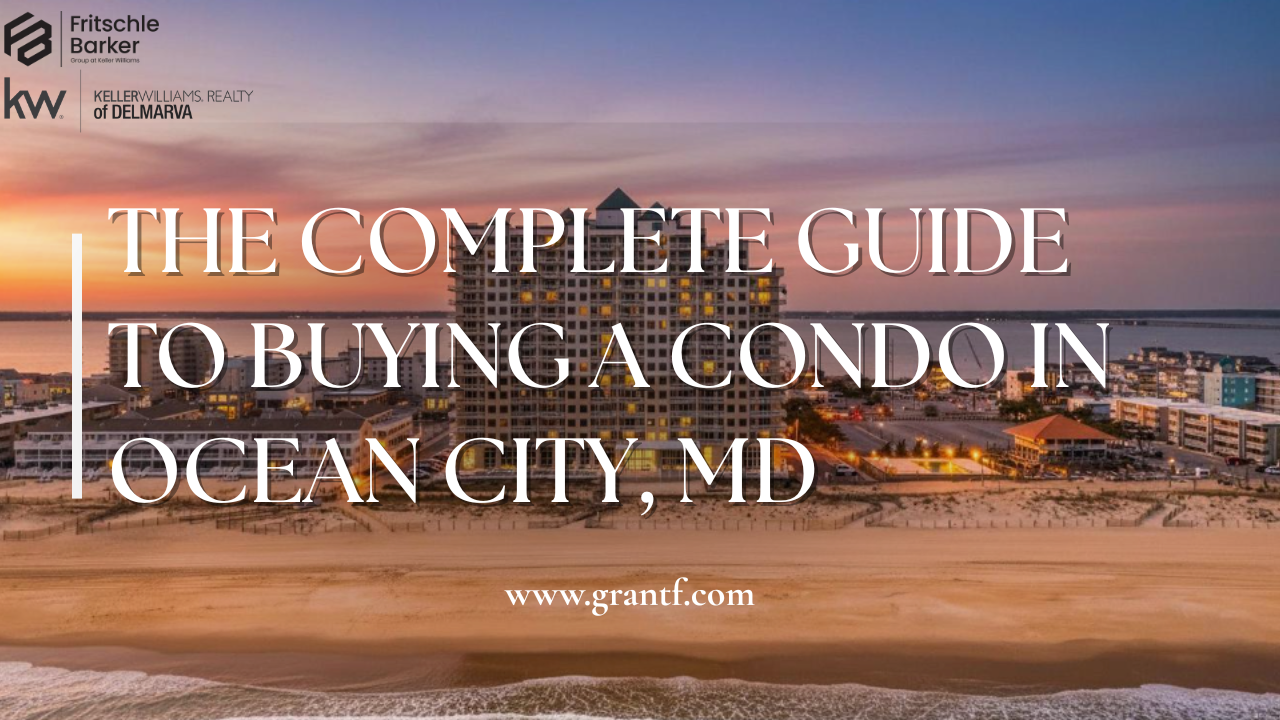
The Complete Guide to Buying a Condo in Ocean City, MD
Buying a condo here is a building decision before it is a unit decision. This guide gives you condominium-only market data, what condo fees actually buy, how financing turns on the building rather than the buyer, and an honest read on rental income.
Jump To Section
- Quick Answer
- Key Takeaways
- Before You Search: Know Who You Are at the Beach
- What the Ocean City Condo Market Looks Like Right Now
- Where Should You Buy an Ocean City Condo?
- How Much Are Condo Fees in Ocean City?
- What Condo Documents Should You Read?
- How Do People Pay for Ocean City Condos?
- Can an Ocean City Condo Pay for Itself?
- What Are the Steps to Buying a Condo in Ocean City?
- Who Pays the Buyer's Agent?
- How Do You Find a Good Ocean City Agent?
- What Mistakes Do First-Time Buyers Make?
- Ocean City Condo Buying FAQ
- Why You Can Trust This Guide
- Helpful Ocean City Condo Resources
Quick Answer
Buying a condo in Ocean City comes down to four things, in this order: being honest about how you will actually use it, understanding the building rather than just the unit, financing it correctly, and having realistic expectations about rental income.
In the six months ending August 28, 2026, the median Ocean City condominium sold for $425,000, in a median of 45 days, at 97.7% of asking price. The median monthly condo fee was $458. Those figures are condominium sales only. Single-family and fee-simple sales are reported separately further down, because blending them overstates the condo market. For the broader market across all property types, see our Ocean City MD real estate trends for 2026.
The single most important thing to understand is that this market runs on buildings, not neighborhoods. Two buildings across the street from each other can differ enormously in reserve funding, assessment risk, rental rules, insurance structure, financing, and long-term ownership cost. None of that shows up in a listing photo, and all of it shows up in what the property costs you to own.
Key Takeaways
- Median Ocean City condominium: $425,000, 45 days on market, 97.7% of list.
- Median monthly condo fee: $458.
- Condos and single-family homes here are different markets, not two versions of one.
- The building matters more than the unit. Reserves, assessments, insurance, and rental rules are the real product.
- Water views carry a large and measurable premium.
- Vacation rental status currently carries no purchase-price premium at all.
- The lower end of the market is the slow end, not the top.
- Condo financing depends on the building, not just the buyer.
- Do not stretch. This is a discretionary purchase, and it should not create stress.
Before You Search: Know Who You Are at the Beach
Short answer: decide how you will actually use the property before you look at a single listing. It determines area, building, and unit type more than most buyers realize.
Before Zillow, before showings, before falling in love with a balcony photo, answer one question honestly:
Who are "you" when you come to Ocean City?
Are you quiet mornings, coffee on the balcony, and an empty beach? Or are you the Boardwalk, a full weekend, and wanting to be where things are happening? Are you buying a place you will use, a property that needs to earn its keep, or something in between?
It is one of the most expensive decisions on the list. We have watched buyers choose the wrong building, the wrong block, and the wrong floor plan because they were buying for the version of themselves they imagined at the beach rather than the one who actually shows up.
A condo that is perfect for rental income may not be the condo you want to use every weekend. A condo that feels peaceful in October may feel too far from the action in July. A condo with the lowest monthly fee may turn out to be the most expensive one to own. If you are still deciding between parts of town, our guide to which part of Ocean City suits which buyer covers that question in more depth.
The right search starts with the right self-awareness.
The One Piece of Advice Grant Gives Every First-Time Buyer
Grant's advice to first-time Ocean City condo buyers is simple:
"A lot of times clients will have these dreams and goals and expectations of what they want us to be and what they want it to look like. And too often, I see buyers reaching to accomplish that. Reaching outside of their comfortable price range. Here's my belief. This is a vacation home. It should never cause you stress or anxiety to own it. Under buy! And that way, if you don't use it enough, you're not stressed. If it doesn't rent exactly as many weeks as you thought, you're not stressed. Don't reach."
That is the whole philosophy in five sentences.
Nobody in Ocean City "has" to buy anything. This is a second home, vacation home, investment property, or lifestyle purchase. It should make your life better, not more anxiety filled. A property you 'stretched for' stops being a beach house, and it turns into a burden and an 'expense'.
A real example: a buyer we were working with once chose between two condos they liked, and they picked the one simply because of the lower monthly HOA fee (against our advice). Within a year, that fee had tripled and a special assessment was passed by the HOA. The other condo, with the slightly higher fee, had more amenities, a healthier association, and a lower total cost over time.
Low condo-fees are not the same as low costs. That lesson repeats all over Ocean City.
What Most Buyers Miss About Ocean City Condos
Most buyers think they are buying the unit. They are ... But they are also buying the building.
They are buying the association budget. They are buying the financial health and reserve balance. They are buying the maintenance history. They are buying the insurance structure. They are buying the rental rules. They are buying the likelihood (or not) of future special assessments.
That is why two properties that look similar online can be completely different ownership experiences.
One building may have a higher condo fee because it is properly funding reserves, maintaining the exterior, carrying better insurance, and staying ahead of capital repairs. Another may look cheaper because it has kept fees artificially low and pushed expenses into tomorrow.
"Tomorrow", in a condominium, often shows us as an assessment. That's the mistake buyers can make if they shop only by price, view, photos, and monthly condo-fees.
What the Ocean City Condo Market Looks Like Right Now

Short answer: the median Ocean City condominium sells for $425,000 in about 45 days at 97.7% of asking. Condo inventory is balanced at roughly five months of supply.
Here is what condominium sales actually look like across Ocean City and West Ocean City over the trailing 180 days ending August 28, 2026.
| Metric | Condominiums only |
|---|---|
| Closed sales | 413 |
| Median sale price | $425,000 |
| Median days on market | 45 |
| Median sale-to-list ratio | 97.7% |
| Median monthly condo fee | $458 |
| Active condo listings | 327 |
| Months of supply | About 4.8 |
Filter: condominium ownership only, Ocean City and West Ocean City, closed sales above $50,000, trailing 180 days ending August 28, 2026. Source: Bright MLS.
This is not a distressed market. It is not a runaway market either. It is a building-by-building market.
Some buildings move quickly because buyers trust the association, the location, the rental history, the amenities, and the long-term ownership picture. Others sit because buyers are reading the same documents you should be reading: reserves, assessments, insurance, litigation, meeting minutes, and future capital needs. Our monthly Ocean City market report tracks how those patterns move month to month.
Condos and Houses Are Not the Same Market
This is where a lot of Ocean City data goes wrong, including our own earlier version of this page. It blends condominiums and single-family homes together and calls the result a condo number.
That is a problem, because it didn't deliver completely accurate findings.
| Property Type | Closed Sales | Median Sale Price | Median Days on Market |
|---|---|---|---|
| Condominiums | 413 | $425,000 | 45 |
| Single-family and fee simple | 225 | $503,000 | 41 |
Filter: Ocean City and West Ocean City, closed sales above $50,000, trailing 180 days ending August 28, 2026, split by ownership type. Source: Bright MLS.
That is a $78,000 gap in the median. Anyone quoting a blended number as "the Ocean City condo price" is overstating the condo market. Buyers budgeting off that number are shopping with the wrong anchor.
Grant's framing on why these are separate markets rather than two flavors of one:
"It's like saying, what's the difference between a buyer that purchases a Ford F-150 and a buyer that purchases a Ford Mustang? They're buying for completely different needs and wants and expectations."
And on why single-family metrics behave so differently here:
"If you actually look at the makeup of Ocean City, there are, on a scale, there's far fewer single family homes in existence in Ocean City than condos. So if you're looking for a single family home on the water, under a million dollars, when something pops up you need to react quickly, we don't get 600 of those properties for sale in a year ... we might get a 5-7 of those opportunities. So yes, you're going to have to make a decision and move a lot quicker than you would if you're looking for a condo."
That is a structural scarcity point, not a market-timing point.
Price Tiers, Condominiums Only
| Price Tier | Sales | Median Price | Median DOM | Sale-to-List |
|---|---|---|---|---|
| Under $250K | 44 | $225,000 | 67 days | 95.7% |
| $250K to $400K | 132 | $318,000 | 63 days | 97.6% |
| $400K to $600K | 138 | $478,000 | 28 days | 98.1% |
| $600K to $900K | 72 | $722,500 | 29 days | 97.7% |
| $900K to $1.5M | 24 | $1,152,050 | 30 days | 97.6% |
| Over $1.5M | 3 | $1,846,620 | 3 days | 100.2% |
Filter: condominium ownership only, Ocean City and West Ocean City, closed sales above $50,000, trailing 180 days ending August 28, 2026. Source: Bright MLS.
The slow end of this market is the bottom, not the top. Everything under $400,000 is taking roughly twice as long to sell as everything above it, and the under-$250,000 tier is also the only one closing meaningfully below asking at 95.7%. That runs against the instinct that cheaper property always moves faster.
However, it is worth understanding (before you price an offer, or a listing) that in Ocean City, lower price sometimes means older buildings, smaller units, financing challenges, higher condition concerns, weaker associations, or buyer hesitation around total ownership cost.
Moving on, and looking at those properties priced above $400,000, condos are selling in about a month at close to full asking. And the over-$1.5M row covers three sales, so treat it as an illustration, not a trend.
Where Should You Buy an Ocean City Condo?
Short answer: the zones behave differently on price and pace, but the specific building matters more than the zone. Water views carry the clearest premium.
| Area | Condo Sales | Median Price |
|---|---|---|
| Bayside Waterfront | 96 | $460,000 |
| Ocean Block | 93 | $380,000 |
| Bayside Interior | 91 | $318,000 |
| Direct Oceanfront | 90 | $499,500 |
| Oceanfront, Indirect View | 30 | $527,250 |
| West Ocean City | 13 | $645,000 |
Filter: condominium ownership only, closed sales above $50,000, trailing 180 days ending August 28, 2026. Source: Bright MLS.
Two cautions on this table.
First, area medians reflect what sold, so unit size and bedroom count move them as much as location does.
Second, the West Ocean City row rests on 13 condo sales, which is a small sample carrying a high median because West Ocean City condominium product skews larger.
The water-view premium is the clearest signal in the data. Condominiums with a water view sold at a median of $485,000. Condominiums without one sold at a median of $367,500. That is a spread of roughly $117,500, and it is wider than the gap between many of the zones above.
What the Zones Actually Mean
Direct Oceanfront. On the sand. Direct oceanfront is what many buyers picture first: beach outside, views, sunrise, balcony, and usually the strongest rental demand. It often comes with higher prices, higher condo fees, more building systems, more amenities, and more exposure to salt, wind, and weather. The Gateway Grand and Golden Sands are two oceanfront buildings we know well and write about in detail.
Oceanfront can be wonderful. It is not automatically simple.
Ocean Block. Ocean block means ocean side of Coastal Highway, but not directly on the beach. This is often one of the best value categories in Ocean City. You give up direct sand-front location, but you can still be a short walk from the beach at a meaningful discount.
For buyers who want beach access without paying the direct oceanfront premium, ocean block deserves a serious look.
Bayside Waterfront. Bayside waterfront includes canal-front, bayfront, and water-view properties off the ocean. This is where sunsets, boats, decks, and slips become part of the conversation. Slip ownership, slip assignment, canal depth, bulkhead responsibility, and whether a slip actually conveys are all frequently misunderstood.
Do not assume a boat slip comes with the property just because the listing photo shows a dock. Ask. Then verify.
Bayside Interior. Bayside interior is off the water and often the most affordable entry point.
It can be a good fit for buyers who want Ocean City access without paying for a water view or oceanfront location. It can also be slower-moving, which may create opportunity if the building is strong and the total ownership cost makes sense.
West Ocean City. West Ocean City is across the Route 50 bridge and behaves differently from the island.
It often has more single-family-style development, larger units, different parking patterns, easier year-round access, and a stronger local-community feel. For buyers who want Ocean City nearby but not outside the front door, West Ocean City can be a very good fit.
Just be careful comparing it directly to island condos. It is a different product.
How Much Are Condo Fees in Ocean City?

Short answer: the median monthly condo fee is $458, with most buildings between $300 and $650. The fee is meaningless without knowing what it covers and how the reserves look.
Across condominium sales in the trailing 180 days ending August 28, 2026, the median monthly fee was $458, with the middle half of the market between $300 and $650. The real range is much wider. Some small buildings are under $200. Some full-amenity oceanfront high-rises are well over $1,500. We break the arithmetic down building by building in our guide to what Ocean City condo fees really cost.
What Drives the Spread?
- Amenities. Pools, garages, fitness rooms, elevators, common areas, and on-site staff cost money.
- Building size and construction. Oceanfront high-rises cost more to operate and maintain than small ocean-block buildings.
- Insurance. Master insurance costs have become a major part of the condo-fee conversation.
- Reserve funding. Well-funded buildings tend to have steadier and more predictable fees.
- Deferred maintenance. A low fee today can become a special assessment tomorrow.
A low fee is not a bargain and a high fee is not a penalty.
A fee that does not fund reserves is a loan against your own future, and the payment comes due as an assessment.
Ask what the fee covers.
Then ask to see the reserve study.
What the Fee Should Cover
Every building is different, but condo fees commonly cover some combination of:
- Master insurance on the structure
- Exterior and roof maintenance
- Common area utilities and cleaning
- Pools and amenities
- Elevators
- Trash
- Management
- Landscaping
- Security or staffing, where applicable
- Reserve contributions
What the fee usually does not cover:
- Your own HO-6 condo insurance policy
- Property taxes
- In-unit utilities
- Interior repairs
- Furniture, appliances, and personal property
- Rental management fees
- Special assessments
The number matters, but the contents matter more.
Reserve Studies and Maryland HB 107
Maryland's condominium reserve-study requirements have made reserve funding a front-and-center buyer issue.
House Bill 107 extended the reserve-study requirement statewide. Under Maryland Real Property Section 11-109.4, a residential condominium must have a reserve study and an updated study at least every five years. For condominiums in Worcester County established before October 1, 2022, the statute set a deadline of October 1, 2023 for that study, so an Ocean City association should already have one.
Three provisions in that section are worth knowing, because they are rights you can use as a buyer:
- The reserve study must be available for inspection and copying by any unit owner, so it is not a document an association can decline to produce.
- The governing body must review it when preparing the annual proposed budget, and a summary must go to owners with that proposed budget.
- Under Section 11-109.2, the reserves in a residential condominium's annual budget must be the funding amount the most recent reserve study recommends.
That last one is the part buyers miss. The study is not advisory reading. It sets the number the budget is supposed to carry, which means a study and a budget that disagree tell you something important about the building before you ever make an offer. Our HB 107 guide for Ocean City condo buyers and our walkthrough of how to read a reserve study and budget cover how to read both documents side by side.
Grant's point about what this is doing to the market right now is worth hearing because it explains price behavior that looks confusing from the outside.
Buildings are diverging. Some are highly desirable and move quickly. Others are working through significant reserve, insurance, maintenance, or assessment issues and move slowly at lower prices. The practical consequence for a buyer: comparable sales inside a struggling building can make you think the whole market has dropped. It has not. You may be looking at one building's problems priced into its units. Compare comps inside a building against that building's financial position, and never as a read on Ocean City as an entirety.
What Condo Documents Should You Read?
Short answer: the condo documents tell you what the photos cannot. Read the budget, the reserve study, the minutes, the insurance, and the rules before you commit.
Before you are fully comfortable with an Ocean City condo purchase, review the documents that explain the building, not just the unit.
That usually includes:
- Condominium bylaws and rules
- Current budget
- Recent financial statements
- Reserve study
- Recent meeting minutes
- Master insurance information
- Rental rules and minimum-stay rules
- Pet rules
- Parking and storage rules
- Known or pending special assessments
- Litigation disclosures, if any
- Resale package documents
- Management company contact information
This is the step buyers most underestimate. A pretty unit in a weak building is not a bargain. A dated unit in a strong building may be a better purchase than it looks. If the building is governed by a secondary association as well, our guide to Ocean City HOAs explains how those layers stack.
How Do People Pay for Ocean City Condos?
Short answer: about 63% of recent condominium purchases used conventional financing and about 33% were cash. Lenders underwrite the building as well as the buyer.
| Financing Type | Sales | Share |
|---|---|---|
| Conventional | 259 | 63% |
| Cash | 138 | 33% |
| Other and not stated | 16 | 4% |
Filter: condominium ownership only, Ocean City and West Ocean City, closed sales above $50,000, trailing 180 days ending August 28, 2026. Source: Bright MLS.
One in three condo purchases here is cash.
If you are financing, you will sometimes compete against an offer that carries no appraisal contingency and no loan contingency. Sellers weigh certainty alongside price, especially in buildings where financing can be more complicated.
What Makes Condo Financing Different?
Lenders evaluate the building, not just you.
That is the part buyers miss.
A buyer can be well qualified and still run into trouble if the building does not meet the lender's project requirements.
Common issues include:
- Warrantable versus non-warrantable status
- Reserve funding
- Master insurance coverage
- Litigation
- Recent or pending special assessments
- Investor concentration
- Commercial or non-residential space
- Short-term rental concentration
- Condotel concerns
- Delinquent association dues
- Deferred maintenance or safety issues
This is why your lender matters.
Talk to a lender who has actually financed Ocean City buildings, early. A national lender who has never closed a loan in a specific oceanfront building can discover a problem in week three that a local lender would have flagged on day one.
Can an Ocean City Condo Pay for Itself?
Short answer: it can offset a real share of carrying costs. It rarely produces positive cash flow in year one, and the purchase-price data shows no premium for rental status.
Almost every buyer asks.
The honest answer is that rental income usually helps meaningfully and rarely covers everything. Of the 413 condominium sales in the current data set, 61 were flagged as active vacation rentals at the time of sale, about 15%.
Their median sale price was $425,000, identical to the median for condominiums not flagged as rentals. That is worth sitting with. The market is currently assigning no purchase-price premium at all to rental status. That is good news for a buyer because you are not necessarily paying extra for income history. It also means you should be skeptical of any listing that prices itself higher simply because it rents well. If income is the main reason you are buying, our buyer's guide to Ocean City vacation rentals goes deeper on how to underwrite one.
Gross Rental Income Is Not Net Income
This is where most rental projections fall apart.
A property that grosses $40,000 does not put $40,000 in your pocket. Management fees, turnover cleaning, repairs, condo fees, taxes, insurance, utilities, maintenance, furniture replacement, and owner-use decisions come out first.
Our framing is this:
If rental income covers a meaningful share of your carrying costs while still leaving you the personal use you actually want, that is a good outcome. If the purchase only works because the property cash flows positive in year one, the math will usually disappoint you.
Which brings it back to Grant's rule: Under buy.
What Are the Steps to Buying a Condo in Ocean City?
Short answer: define how you will use it, get pre-approved, tour with building knowledge, offer, read the documents, inspect, and close. Roughly 30 to 60 days when financed.
Grant walked this end to end on tape, and the sequence below is his.
- Separate what you want from what you need, and tell your agent both. This is step one, not filler.
- Choose your area. Downtown, Midtown, North Ocean City, High-Rise Row, oceanfront, ocean block, bayside, or bayside waterfront.
- Choose your property type. Large building or small, condo or townhome, and what that means for fees and how you will use it.
- Decide which amenities matter. Everybody loves a pool, but a pool changes the condo fee. Amenities are a cost, not a free feature.
- Focus on good buildings and good associations. This filter matters more than any other.
- Get pre-approved with a budget that includes fees, taxes, and insurance, not just the mortgage.
- Make the offer. By this point there should be very few open questions left.
- Inspect with someone who understands coastal property: salt-air corrosion, balconies, HVAC age, exterior exposure, and shared systems.
- Read the condominium documents: bylaws, financials, reserve study, rules, minutes, and insurance.
- If you plan to rent, interview management companies and set realistic expectations before you close.
- Settle, use it, and enjoy it.
What Should You Ask Before Writing an Offer?
Grant's answer surprised us, and it is the right one:
"I really don't know that there should be many questions left when you're getting to the offer. Because we're gonna be talking it all through and explaining, setting those expectations well before. Offer's a time of confidence."
If you are still discovering fundamental facts about the building when you are writing an offer, the work happened in the wrong order. The questions belong at the start. By the time you write, you should understand the building, the fee, the rental rules, the financing path, the documents you need to review, and the likely ownership costs. The offer should be the moment you act on a decision, not the moment you start learning the basics.
Who Pays the Buyer's Agent?
Short answer: in Ocean City the seller commonly compensates the buyer's agent through arrangements between brokerages, but it is negotiable and not guaranteed.
Buyer agent compensation in Ocean City is still commonly paid by the seller through cooperative arrangements between brokerages, so as a buyer you often do not write a separate check.
That is not universal.
Since the 2024 NAR settlement, buyer agent compensation is negotiated more visibly, and there are transactions where a buyer may compensate their own agent in part or in full.
All compensation is negotiable and is set by agreement, not by any standard or customary figure.
A good buyer's agent explains their compensation in writing before you tour anything. We walk through how the mechanics work in who pays the buyer's agent in Ocean City.
How Do You Find a Good Ocean City Agent?
Short answer: look for coastal specialization, real transaction history in your property type, and willingness to tell you which buildings they would avoid.
In a market this building-driven, the agent choice has outsized consequences. A generalist from an inland market does not know which buildings have thin reserves, which stacks get the light, which associations are well run, which buildings have rental restrictions, or which ones may have assessment risk.
What to look for:
- Ocean City is their primary market, not a side market.
- They have real transaction history in your property type and price range.
- They can explain condo fees, reserves, assessments, insurance, and rental rules.
- They have references from buyers, not only sellers.
- They give honest answers about buildings, including the ones they would not recommend.
- They have a structure that gets you a fast response.
- They know which lender questions to ask before you are under contract.
One first-time Ocean City condo buyer described the difference this way:
"Grant was an excellent buyer's agent. We just purchased our first OC condo and it was clear that he knew every building inside and out. He didn't just open the door for us to tour, he provided invaluable insight into the building itself and HOA at each stop. He was quick to respond, communicated clearly, and helped us find the place that was right for us ..."
Jesse H., first-time Ocean City condo buyer
That is what a buyer's agent should do here. Open the door, yes. But also explain what you are walking into, and help you determine if it fits your short and longer-term goals. If you want a fuller checklist for the interview, we keep one in our guide to choosing a real estate agent in Ocean City.
What Mistakes Do First-Time Ocean City Condo Buyers Make?
Short answer: reaching beyond budget, shopping price before lifestyle, trusting rental projections, skipping the documents, and hiring a generalist.
1. Reaching
This is the most common and most costly mistake.
A vacation home you stretched for produces stress instead of the thing you bought it for.
2. Shopping Price Before Lifestyle
The wrong building at $400,000 is a worse outcome than the right building at $500,000, or at $350,000.
Price matters, but it does not answer the lifestyle question.
3. Underestimating Carrying Costs
Condo fees, taxes, insurance, utilities, maintenance, repairs, furnishings, rental wear and tear, and the occasional assessment all matter.
The mortgage is only part of the conversation.
4. Trusting Rental Projections
Gross is not net.
Run conservative numbers and remember the current data showing no purchase-price premium for rental status.
5. Skipping the Documents
Bylaws, financials, reserve study, meeting minutes, insurance information, and rules tell you what you are actually buying into.
Do not treat them like paperwork.
Treat them like the owner's manual.
6. Chasing the Lowest Condo Fee
Often the most expensive decision in the transaction.
The lowest fee is only good if the building is still being properly maintained and funded.
7. Assuming Every Building Can Be Financed the Same Way
They cannot. The lender reviews the building as well as the buyer. Some problems are fixable. Some are not. Some only change the loan product, the down payment, or the lender. Some can kill a deal entirely. Find out early.
And if you are on the other side of this transaction one day, the same building facts drive the sale: our guide to selling an Ocean City condo works the problem in reverse.
Ocean City Condo Buying FAQ
How much does a condo in Ocean City cost?
The median condominium sold for $425,000 in the six months ending August 28, 2026. The largest segments of the market are between $250,000 and $600,000. Figures that blend condos with single-family homes run considerably higher and should not be treated as condo prices.
Are Ocean City condo fees expensive?
The median monthly condo fee is about $458, with most buildings between $300 and $650. Small buildings can be under $200, and full-amenity oceanfront high-rises can exceed $1,500. What the fee covers and how the reserves are funded matter more than the number itself.
Can I rent my condo out as a vacation rental?
It depends entirely on the building. Some buildings allow short stays, some require a week or month minimum, and some prohibit rentals. Confirm the rules before you make an offer, never after.
How much do I need to put down?
Usually more for a second home than a primary residence, and more again for an investment property. Buildings classified as non-warrantable or treated as condotels can require different financing, larger down payments, or portfolio loans. Your lender sets this, so ask early.
Are Ocean City condos a good investment?
As a property you use that also offsets some of its costs, frequently yes. As a pure cash-flow investment with no personal use, the math is tighter. Current data shows no purchase-price premium for rental status, and gross rental income is not the same as net income.
What is the difference between oceanfront and ocean block?
Oceanfront buildings sit directly on the sand. Ocean block buildings are on the ocean side of Coastal Highway but not on the beach. Ocean block often offers a meaningful discount for a short walk. Water views carry a large premium either way, currently about $117,500 at the median.
How long does buying take?
Typically 30 to 60 days from accepted offer to settlement. Cash can be faster. Financing needs time for appraisal, document review, project review, and underwriting.
Why is the cheaper end of the market slower?
Condominiums under $400,000 are taking roughly twice as long to sell as condominiums above it, and the under-$250,000 tier closes furthest below asking. Buyer financing constraints, building condition, association issues, and older inventory often concentrate at that end.
Should I buy a condo or a single-family home in Ocean City?
They are genuinely different products. Single-family means your own insurance, maintenance, storm preparation, lawn, systems, and exterior responsibility, with far less inventory to choose from. A condo means you can arrive, unlock it, use it, lock it, and leave, with shared building responsibility and association rules. Neither is better. Choosing the wrong one is the expensive mistake.
What is a reserve study?
A reserve study evaluates the major future repair and replacement needs of a condominium association and helps estimate how much money the association should be setting aside. In Ocean City, reserve studies matter because salt air, wind, water exposure, elevators, roofs, balconies, pools, and exterior systems all cost real money over time.
Helpful Ocean City Condo Resources


Your Top Ocean City, MD Real Estate Agents
Today, they are recognized nationally as a top-performing group of charismatic, skilled Agents deeply connected to the vibrant towns of the Eastern Shore. More than agents, they are trusted advisors and community advocates, blending local knowledge with national strategy to deliver exceptional results.
The Fritschle Barker Group at Keller Williams Realty of Delmarva adheres to all Fair Housing Act guidelines and NAR ethical standards.