
Uncovering Ocean City's Closing Costs: A Buyer's Guide
If you're a home buyer in Ocean City, MD (or the surrounding areas) understanding closing costs is crucial. Buying at the beach is much different than most primary home markets.
Closing costs are part of any normal real estate transaction. This may be an elementary concept for many, but we feel it's still important to mention as we begin this blog.
Today, we'll explain what closing costs are, what some of the most common closing costs are in Ocean City and give you a rough estimation of how much you should expect to pay. Let's Dive right in!
What exactly are Closing Costs?
As we mentioned before, closing costs are something that both buyers and sellers incur when they are buying or selling a home. Some closing costs are calculated based on the purchase price of the home, while others are flat fees charged by homeowner’s associations, title companies, etc.
Some of your closing costs are paying for services completed by companies or people assisting you in completing the transaction. Others go to the government (hooray). Others go into an escrow account to cover things such as property taxes and homeowners’ insurance.
Keep in mind, there’s no way we could cover every single closing cost that ever existed. Each real estate transaction is different, and we tried to highlight those that are either specific to Ocean City or are a standard closing cost.
Key Closing Costs in Ocean City

1. Association Fees- Capital Contribution & HOA Fees
Let's start this section off with what a capital contribution fee is, and how they apply to properties in Ocean City, MD. When you're purchasing a home, condo, townhome, or any other type of real estate that is in a homeowner’s association, there's a chance that you'll have to pay what is called a Capital Contribution.
We could go on and on speculating about what exactly a capital contribution fee is for. However, at the end of the day it boils down to this... A capital contribution fee is a fee that is paid by purchasers in a condo or homeowner’s association when they become a part of the association.
Truthfully, a capital contribution is just another way for associations to help build up their funds. Think of it like an initiation fee to a country club. You're a new member, and you've got to pay to get in!
With all of that said we should also mention that not all homeowners’ associations and condo associations at the beach have a capital contribution fee. However, you still shouldn't be surprised by this, and your realtor should inform you as to whether or not this is a fee you're going to have to pay.
Next, we'd like to talk a little bit about HOA fees. While many of you are likely already familiar with HOA fees and exactly what they are, we still feel it's an important topic to cover.
When you're purchasing a home in Ocean City, MD that's a part of an HOA, it's more than likely that the current owners of that home pay their HOA dues in one of a few ways- annually, quarterly, or monthly.
So, what happens if you're set for a closing date on June 15th?
If this association's dues are paid on an annual basis, then you'll have to reimburse the seller for the fees through the end of the year. The seller probably paid these dues in the beginning of the year upfront. So essentially, you have to cover the cost for June 15th through December 31st, and the seller is responsible for January 1st through June 14th.
The same thing goes for monthly and quarterly dues. If you are closing on a home in the middle of a period, the seller is responsible for every day up to closing, and you're responsible for everyday thereafter.
2. Special Assessments
If you've been paying attention to real estate in Ocean City, MD, you probably know that special assessments are a bit of a "hot topic" right now.
If you'd like to know a bit more about what exactly brought all of these special assessments to Ocean City, check out this YouTube video we made on the new Maryland HB-107 law!
In short, special assessments are fees that owners in an association must pay in order to build up a sub-par reserve fund. A reserve fund is money an association uses to repair things such as stairwells, roofs, and other common elements in a condominium or association.
If you're purchasing a condo in Ocean City in an association that has levied a special assessment on its owners, this is likely something you're going to have to negotiate with the seller (or buyer if you're the seller).
Some sellers will come right out and offer to pay for that year’s special assessments. Others will ask to split that year’s special assessment. At the end of the day, you need make sure you know how much the total special assessment is, and how much of it you're responsible for.
If you're purchasing a condo that has a special assessment, you should be discussing the details at length with your realtor, CPA (if you have one), and lender to make sure this isn't going to be too much of a cost for you to incur.
3. Title Fees
Next up is title fees. Title fees are fees that go to the title company, and title insurance companies.
Title companies complete searches to ensure the seller is who they say they are, that they have the right to sell the property, and that there are no liens against the property.
To help you understand exactly what you're paying to the title company, here's an example of title fees one of our recent buyers paid.
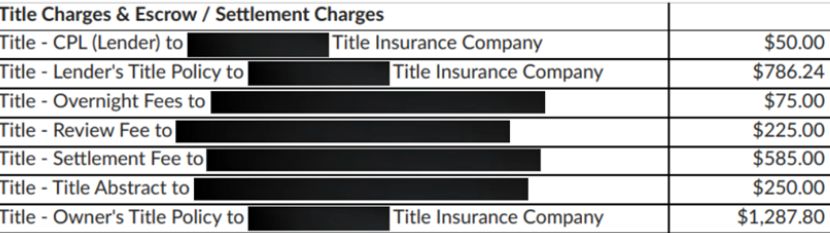
In this example, you can see that the buyer was responsible for paying for many things related to the title of their new home. Let's break them down one by one.
Line 1- First, we have the CPL to the title insurance company. This is an agreement between the title insurance company and the lender and essentially protects the lender from any losses incurred at closing.
Line 2- Next is the Lender's title policy. This protects a mortgage lenders interest in the property in case there are title issues down the line. Think of it like title insurance- but for the lender.
Line 3- Third we have "overnight fees." This is a cost that some title companies have, and others don’t. It’s just you paying them to ship important documents related to the title of the home.
Line 4- Next up is the review fee to the title company. This is a charge for the time the title company spends reviewing the title of the home.
Line 5- The fifth line item in this example is a settlement fee. This is a charge for the title companies’ services to complete settlement for you. When you purchase a home, you'll meet a title company representative to sign all of the required documents to fully complete the transaction.
Line 6- Next we have the title abstract. A title abstract is a document that summarizes the ownership history of a piece of real estate. This includes all of the past owners, any liens against the property, encumbrances, so on and so forth.
Line 7- Last, but CERTAINLY not least, is your title insurance policy. A title insurance policy is something we ALWAYS recommend because of the future protection it offers homeowners. In short, this policy protects you from anyone coming after your rightful ownership of the home down the line.
All of these items are standard charges that are, in our opinion, are more than worth it because of the protection they offer.
4. Transfer Taxes and Recordation Charges
Now we're onto transfer taxes and recordation charges. To summarize, transfer taxes and recordation charges are the fees you pay to the government to transfer and record this property into your name.
Here's an example of this section in the closing documents for a buyer who purchased a $320,000 property:

As you can see, these charges are split between the buyer and the seller. In this example, the dollar amounts on the left are for the seller, and the dollar amounts on the right are for the buyer.
In Maryland, these charges are incurred for any property sale and are generally around 1.66% of the purchase price. Split evenly between the buyer and the seller, you're responsible for about 0.88%.
5. Lender Fees
Our last section is going to be focusing on lender fees. These fees are those that the lender needs to collect for providing you with a loan. Keep in mind these amounts can fluctuate and are different for every home purchase.
Here are a few good examples of lender fees to expect:
Origination Charge- This is a fee that is paid to the lender for originating the loan. This covers the price of preparing everything that's required to get you your mortgage loan.
Appraisal Fee- An appraisal fee is relatively self-explanatory- it's simply the fee you pay for the lender to have an appraisal done!
Prepaid Interest- This is any interest that you need to pay the lender in between the timeframe of closing and your first mortgage payment.
Strategies to Manage Closing Costs

As a homebuyer, there are a few things you can do to try to limit your closing costs. First things first, you can shop around for different service providers. If one title company, lender, or insurance agent is charging you higher prices or fees that another isn't, you might want to consider going with the more budget friendly option!
Just remember, sometimes the age-old adage of "you get what you pay for" can be true.
Pro Tip: This is a great question to ask your realtor. Often times, they know of at least a few good title companies and mortgage lenders.
Next, you can always negotiate for the seller to cover some of your closing costs. If you're buying new construction, this is a great negotiation tactic. It helps the builder show a higher sale price to the public- all while you get money off on closing costs!
Understanding Your Closing Costs

When you purchase a home, a few days before settlement you will receive a final estimate of your closing costs from your title company and lender.
When you receive this document READ IT, and make sure you understand everything. Your realtor should be reviewing this as well to make sure that there aren't any silly mistakes.
If you see something that you don't understand or see any additional costs you aren't sure about, don't hesitate to reach out to your realtor or title company.
Yes, as realtors our main focus is centered on the real estate market and helping you through the process of purchasing the beach home of your dreams. However, that doesn't mean we haven't seen our fair share of ALTA's and Closing Docs. Often times, we're able to answer any questions you might have.
Conclusion
Buying a home in Ocean City, MD, or anywhere else can be a stressful ordeal. In our opinion, one of the most stressful things about it is that you're spending your hard-earned money on this property... so you want everything to be right!
That's why we feel it’s important you understand all there is to know about closing costs when purchasing a home. If you ever have any questions about closing costs, or anything Ocean City related, don't hesitate to give us a call.
Thanks for reading! See you next time!
Grant Fritschle
Email: grant@grantf.com
Cell: 410-430-5880
Office: 410-524-6400
Jon Barker
Email: jon@markf.com
Cell: 410-935-3810
Office: 410-524-6400
See you at the beach soon!